Dell Tower i7-7700 Desktop Review: Is It an AI Workstation?
A renewed quad-core desktop occupying an artificial intelligence workstation shelf reveals where low hardware costs stop serving demanding technical teams.
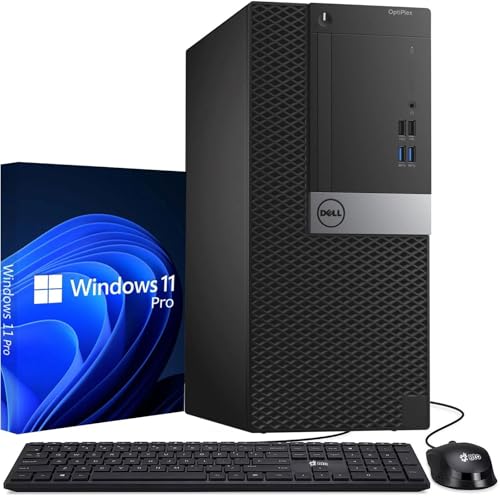
The Dell Tower Desktop PC, Intel Core i7-7700 7th Gen Processor is an entry-level office computer rather than a true artificial intelligence workstation. Skip this machine if your business needs to run local model inference, complex data pipelines, or heavy graphics rendering without adding aftermarket hardware.
Check price on Amazon →The Dell Tower Desktop PC, Intel Core i7-7700 7th Gen Processor is an entry-level refurbished office desktop that cannot run local artificial intelligence (AI) inference without aftermarket hardware upgrades. It handles standard administrative workloads. Online retail categories label it as an AI workstation, yet the hardware lacks a dedicated graphics processing unit (GPU) for machine learning workloads.
Modern business automation requires substantial memory and computational throughput. This tower supplies basic quad-core performance, sixteen gigabytes (16GB) of system memory, and a small solid state drive (SSD). The following sections evaluate every listed component to guide your purchasing decision.
Dell Tower Desktop PC, Intel Core i7-7700 7th Gen Processor Overview and Ideal Users
The Dell Tower Desktop PC, Intel Core i7-7700 7th Gen Processor serves primarily as a general-purpose business desktop rather than a specialized computing workstation. It handles standard office duties reliably. The quad-core architecture and integrated graphics platform suit standard administrative workflows where staff spend working hours in web browsers and office applications.
Small and mid-sized business teams seeking an AI workstation will encounter immediate computational roadblocks with this stock machine. Neural networks demand massive parallel processing. Technical professionals managing local language models, complex compilation tasks, or computer-aided design (CAD) rendering must seek enterprise systems with dedicated hardware.
Evaluating this desktop accurately requires separating retail marketplace categorizations from physical hardware realities. Retail category tags often misrepresent capabilities. For basic clerical duties, customer record lookups, and multi-tab browser navigation, this machine supplies an accessible and stable business environment.
- Best for: front-office administrative desks, customer service workstations, cloud-based productivity software, and general business documentation.
- Acceptable for: secondary office stations requiring a stable Windows 11 Pro environment for basic clerical multitasking.
- Skip it if: your team executes local artificial intelligence model inference, complex 3D CAD modeling, or heavy machine learning workflows.

First Month Free
Get one month of Starlink free when you sign up through this link. Fast, reliable internet at home and on the go.
Processor Performance and Core Hardware Capabilities
The Intel Core i7-7700 central processing unit (CPU) provides four physical cores and eight threads with a 3.6 gigahertz (GHz) base frequency and a 4.2GHz turbo clock speed. Single-threaded office programs run briskly. However, modern mathematical data analysis and multi-threaded script execution saturate four legacy cores almost immediately during sustained operational runs.
System memory consists of 16 gigabytes (16GB) of double data rate four (DDR4) random access memory (RAM). This capacity supports ordinary workplace multitasking. For local artificial intelligence workflows, sixteen gigabytes represents a strict bottleneck because operating system overhead consumes several gigabytes before any model weights load.
Primary storage relies on a 256 gigabyte (256GB) solid state drive (SSD) that ensures rapid operating system boot intervals. Capacity constraints appear quickly in commercial environments. After Windows 11 Pro system files and workplace productivity suites occupy drive space, limited capacity remains available for enterprise datasets and application archives.
Physical Tower Expansion Room and Workplace Fit
The full-sized desktop tower chassis provides interior volume and cooling clearance that compact mini PCs and cramped small form factor (SFF) cases cannot match. Air moves freely through the enclosure. This interior clearance prevents thermal throttling during extended operational runs and grants easy physical access to internal expansion slots without specialized tooling.
Dell packages this renewed machine with a bundled keyboard, mouse, and Wi-Fi capability to create an operational desktop immediately upon delivery. Wireless networking simplifies remote workspace deployment. Windows 11 Pro arrives pre-installed, supplying enterprise security protocols, BitLocker drive encryption, and remote desktop connection tooling for central administration.
Deploying a standard tower chassis requires deliberate planning regarding office desk arrangements and physical floor space. Full towers demand dedicated floor room. In return for that footprint, the chassis grants physical room for adding secondary storage drives as company data requirements increase.
- Chassis thermal design: full tower dimensions permit natural air circulation that keeps internal components cool under routine business workloads.
- Physical expansion potential: internal PCIe slots and drive bays accommodate aftermarket storage drives and expansion cards within power limits.
- Complete peripheral bundle: included keyboard, mouse, and wireless Wi-Fi adapter allow immediate workplace connection without secondary purchases.
Workstation Limitations and Hardware Bottlenecks
The complete absence of a dedicated graphics card represents the defining performance bottleneck for any team evaluating this machine as an AI workstation. Neural networks require specialized parallel execution. Relying on integrated processor graphics forces all tensor calculations onto general CPU cores, producing unacceptably slow response times for local inference.
Storage capacity and system memory ceilings impose secondary operational limits on professional workstation workflows. A 256GB SSD cannot house large project archives alongside daily office software. Furthermore, sixteen gigabytes of RAM prevents your team from running virtual containers and large analytical dataframes without causing severe performance slowdowns.
The renewed classification of this desktop includes a limited ninety-day supplier warranty window. Ninety days of coverage passes quickly. Standard enterprise desktop purchases typically feature three years of warranty coverage, meaning this abbreviated protection period places hardware replacement risks onto company budgets.
- No discrete graphics processor: integrated graphics cannot accelerate matrix mathematics, eliminating practical local neural network model inference.
- Strict storage boundaries: a 256GB solid state drive leaves minimal free room after operating system installations and business software deployments.
- Constrained memory headroom: 16GB of DDR4 RAM restricts parallel execution of virtual containers, complex analytics, and local model parameters.
- Shortened warranty duration: ninety days of renewed warranty coverage offers significantly less operational security than traditional corporate multi-year hardware guarantees.
Specific Criteria That Invert the Purchase Recommendation
Our recommendation against purchasing this computer as an AI workstation flips if your business deploys it strictly as an affordable general office computer. The tower chassis permits modular hardware upgrades. Technical staff can install an aftermarket dedicated graphics card and supplementary hard drives when budget allocations allow workstation expansion.
Our guidance also shifts if your organization relies entirely on cloud-hosted artificial intelligence application programming interfaces (APIs) and web-based services. Cloud workflows offload heavy computations to remote servers. In that operational structure, the quad-core Intel Core i7-7700 processor and 16GB of memory deliver plenty of speed for web productivity.
The negative verdict remains absolute if your business must run proprietary artificial intelligence models locally to satisfy strict data governance mandates. Confidential customer records require local data isolation. Organizations bound by privacy compliance rules must bypass renewed office desktops and invest in dedicated workstations equipped with factory discrete GPUs.
Evaluating the Dell Tower Desktop PC, Intel Core i7-7700 7th Gen Processor Against Alternatives
Examining this Dell tower against competing models on the retail AI workstation shelf reveals where its hardware configuration trails category leaders. The Dell OptiPlex 7050 SFF desktop incorporates the identical Intel Core i7-7700 processor but upgrades system memory to 32GB and expands internal storage to a 1TB SSD. That compact system provides superior out-of-box memory capacity.
Businesses seeking newer processor architectures should evaluate the Dell OptiPlex 3060, Dell OptiPlex 7060 SFF, and Dell OptiPlex 7070 SFF desktops. The OptiPlex 3060 desktop features a six-core Intel Core i5-8500 processor with 32GB of RAM and a 1TB SSD, offering improved multitasking over 7th Gen chips. Higher on the shelf, the OptiPlex 7060 SFF supplies a six-core i7-8700 chip while the OptiPlex 7070 SFF provides an eight-core i7-9700 CPU and Wi-Fi 6E connectivity.
Teams demanding authentic on-premises artificial intelligence performance must skip renewed office computers and invest in modern GPU-accelerated workstations like the Alienware Aurora series. Alienware Aurora desktops equipped with Nvidia RTX 5070 or RTX 5080 graphics cards deliver specialized tensor hardware engineered specifically for machine learning and heavy graphics rendering. Audit your workplace software requirements today to determine whether your business tasks demand dedicated graphics processing before finalizing your purchase of the Dell Tower Desktop PC, Intel Core i7-7700 7th Gen Processor.
Where to buy the Dell Tower Desktop PC – Intel Core i7-7700 7th Gen Processor – 16GB DDR4 RAM – 256GB SSD – Keyboard & Mouse – Wi-Fi – Office, Home, Business Desktop Computer Windows 11 Pro (Renewed)
The Dell Tower Desktop PC, Intel Core i7-7700 7th Gen Processor is an entry-level office computer rather than a true artificial intelligence workstation. Skip this machine if your business needs to run local model inference, complex data pipelines, or heavy graphics rendering without adding aftermarket hardware.
Check price on Amazon →Alternatives worth comparing
If the Dell Tower Desktop PC – Intel Core i7-7700 7th Gen Processor – 16GB DDR4 RAM – 256GB SSD – Keyboard & Mouse – Wi-Fi – Office, Home, Business Desktop Computer Windows 11 Pro (Renewed) is not the right fit, these are the other ai workstations ranking alongside it right now.


Frequently Asked Questions
- Yes, the Dell Tower Desktop PC is suitable for general office business tasks, but it is not equipped for intensive artificial intelligence workloads. It executes spreadsheet calculations, email correspondence, cloud software operations, and routine administrative duties reliably with its quad-core Intel Core i7-7700 processor and 16GB of DDR4 memory. However, businesses seeking a dedicated machine for local model training, automated inference pipelines, or computer-aided design must add a discrete graphics card or purchase a higher-specification workstation.
- Based on its manufacturer listing, this renewed desktop package includes a Dell Tower desktop computer powered by an Intel Core i7-7700 7th Generation processor running at a 3.6GHz base speed and up to 4.2GHz turbo speed. It includes 16GB of DDR4 RAM, a 256GB solid state drive, a pre-installed copy of Windows 11 Pro, a bundled keyboard and mouse, and integrated Wi-Fi connectivity. The hardware carries a ninety-day renewed warranty from the supplier.
- Data science teams, 3D visualization artists, machine learning researchers, and creative studios should not buy this desktop in its factory configuration. Without a dedicated graphics processing unit, this machine cannot run modern neural network models or render complex geometry efficiently. Organizations handling sensitive local data that requires on-premises inference will experience severe performance limitations on this quad-core system.
- This tower desktop sits at the entry-level boundary of the category shelf and trails other best-sellers in memory and processing capabilities. Competing renewed desktops like the Dell OptiPlex 7050 SFF, OptiPlex 7060 SFF, and OptiPlex 7070 SFF offer 32GB of RAM and significantly larger storage drives up to 1TB. For genuine machine learning workloads, top-ranked workstations like the Alienware Aurora RTX 5070 and RTX 5080 deliver modern discrete GPUs with dedicated tensor cores that drastically outperform this system.
- This renewed Dell desktop includes a ninety-day limited supplier warranty. That ninety-day window covers hardware defects and component failures that occur during the initial three months of workplace operation. While ninety days provides immediate reassurance upon unboxing, it is shorter than the standard three-year enterprise coverage typically accompanying brand-new corporate workstations.
Rolling out ai workstations for your business?
Layer3 Labs helps small and mid-size businesses choose, standardize, and deploy the right AI-ready hardware, and the workflows that run on it.
Book a free consultation